
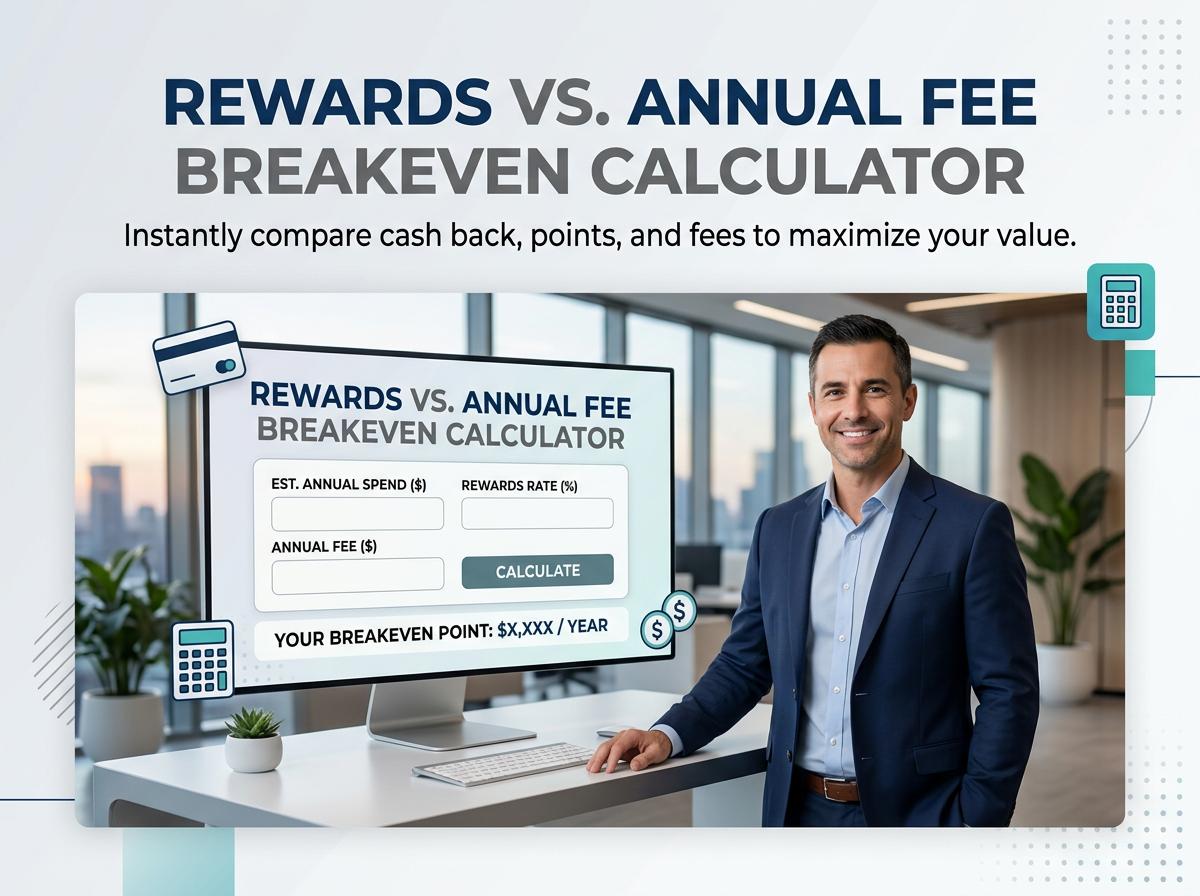

Wondering if a premium credit card is worth the cost? Use our Credit Card Rewards vs. Annual Fee Breakeven Calculator to instantly find out. Simply enter your spending habits to compare cash back, points, and perks against the yearly fee. Maximize your wallet's value and see exactly when you'll come out ahead!
Rewards Breakeven Calculator
What is the exact dollar amount of the card's annual fee?
Because no specific card is mentioned, the exact fee depends on the tier of the credit card you are evaluating. Annual fees generally fall into three distinct categories:
| Card Tier | Typical Annual Fee | Example Cards |
|---|---|---|
| Entry-Level / No Fee | $0 | Chase Freedom Flex, Citi Double Cash |
| Mid-Tier Travel/Rewards | $95 - $250 | Chase Sapphire Preferred, Amex Gold |
| Premium / Luxury | $395 - $695+ | Amex Platinum, Chase Sapphire Reserve |
You must locate the specific "Pricing & Terms" document for your desired card to find the exact legal dollar amount.
How much must I spend in key categories to earn back the fee in rewards?
To calculate your breakeven point, you need to divide the annual fee by the rewards rate. Here is a step-by-step calculation method:
- Identify the Fee: Example, $95.
- Identify the Earning Rate: Example, 3% cash back on groceries.
- Calculate the Breakeven: Divide the fee by the percentage (expressed as a decimal). $95 / 0.03 = $3,166.
- Determine Monthly Spend: Divide by 12. You must spend about $264 per month on groceries just to pay for the card.
Any spending beyond that $3,166 annually represents your actual net profit.
Do the included statement credits match my natural everyday spending habits?
This is crucial for determining the "effective" annual fee. Statement credits only provide true value if they cover items you would have purchased anyway. Common examples include:
- Dining/Delivery: Uber Eats, DoorDash, or specific restaurant credits.
- Travel: Airline incidental credits or general travel statement credits.
- Lifestyle: Streaming services, gym memberships, or retail credits.
If you have to go out of your way or spend extra money to use a $10 monthly dining credit, it does not match your natural spending. This phenomenon is known as "breakage," where issuers profit off unused or forced perks.
What is the actual monetary redemption value of each point or mile?
Point values are not created equal and fluctuate based on the issuer and how you redeem them. Cash back is straightforward (1 point = 1 cent), but travel points vary heavily.
| Redemption Method | Typical Value per Point |
|---|---|
| Cash Back / Statement Credit | 0.5 to 1.0 cents |
| Travel Portal (Flights/Hotels) | 1.0 to 1.5 cents |
| Transfer to Airline/Hotel Partners | 1.5 to 2.0+ cents |
For example, 50,000 points might be worth $500 in cash, but $1,000 if transferred to a partner airline for a business-class flight.
How much more net value does this card offer compared to a free alternative?
To find the true value of an annual fee card, you must calculate its marginal value over a $0 fee card.
Imagine comparing a $95 card that earns 3% on dining to a $0 card that earns 2% on dining:
- The Difference: The paid card earns only 1% more than the free card.
- The Breakeven Spend: To justify the $95 fee strictly on earning rates, you must spend $9,500 on dining ($95 / 0.01).
If you spend less than $9,500 annually in that category, the free alternative actually leaves more money in your pocket, assuming no other perks are considered.
Does the initial sign-up bonus offset the cost of the fee for the first year?
In almost all cases, yes. A competitive sign-up bonus (SUB) typically offers a value between $200 and $1,000+, easily eclipsing standard annual fees for the first year (and often several subsequent years).
However, you must be careful regarding the minimum spend requirement. If a card requires you to spend $4,000 in three months to earn a $500 bonus, you must ensure you can hit that target with natural, responsible spending without carrying a balance and paying interest.
Are the card's highest earning categories aligned with my largest monthly expenses?
A premium card is only valuable if its multipliers match your specific lifestyle. You should perform a quick audit of your last three months of bank statements to categorize your spending:
- Groceries: Look for cards with 3x-6x multipliers at supermarkets.
- Travel & Transit: Look for cards rewarding flights, hotels, and gas.
- Dining: Look for cards heavily rewarding restaurants and takeout.
If your largest expense is wholesale clubs (like Costco) or general online shopping, a card heavily focused on travel rewards will not serve your needs effectively.
Do I actually use the specific partner perks and travel credits provided?
Credit cards often partner with specific brands to justify high annual fees. You must ask yourself if you genuinely use them.
- Airport Lounges: Do you travel frequently enough to use Priority Pass or Centurion Lounges?
- Hotel Status: Do you stay at Marriott or Hilton enough to benefit from free breakfast or late checkout?
- Rideshares: Do you take Uber or Lyft frequently enough to utilize monthly credits?
If these perks sit unused, or if you only use them because the card dictates it, they carry a true monetary value of zero.
Does the card offer a recurring anniversary bonus that lowers the effective fee?
Many mid-tier and premium cards offer a valuable "anniversary bonus" upon card renewal, which effectively subsidizes the annual fee. Common examples include:
- Free Night Certificates: Common with co-branded hotel cards. A $95 fee card might give a free night worth $250.
- Companion Fares: Airline cards often provide a buy-one-get-one ticket voucher annually.
- Point Bonuses: Some cards deposit 10,000 points into your account every year you renew.
If you reliably use the anniversary bonus, the card can often pay for itself year after year.
Will I actively redeem these rewards or let them sit unused in my account?
Points and miles are not investments; they do not accrue interest, and they frequently devalue as airlines and hotels change their award charts.
If you are a passive user who lets hundreds of thousands of points sit idle for years, you are paying an annual fee for an illusion of wealth. You should only pay for a rewards card if you have a proactive redemption strategy—whether that means cashing out every month or booking an annual vacation to zero out your balance.
Sources used for card evaluation metrics:
 Stealth Wealth Net Worth Calculator