
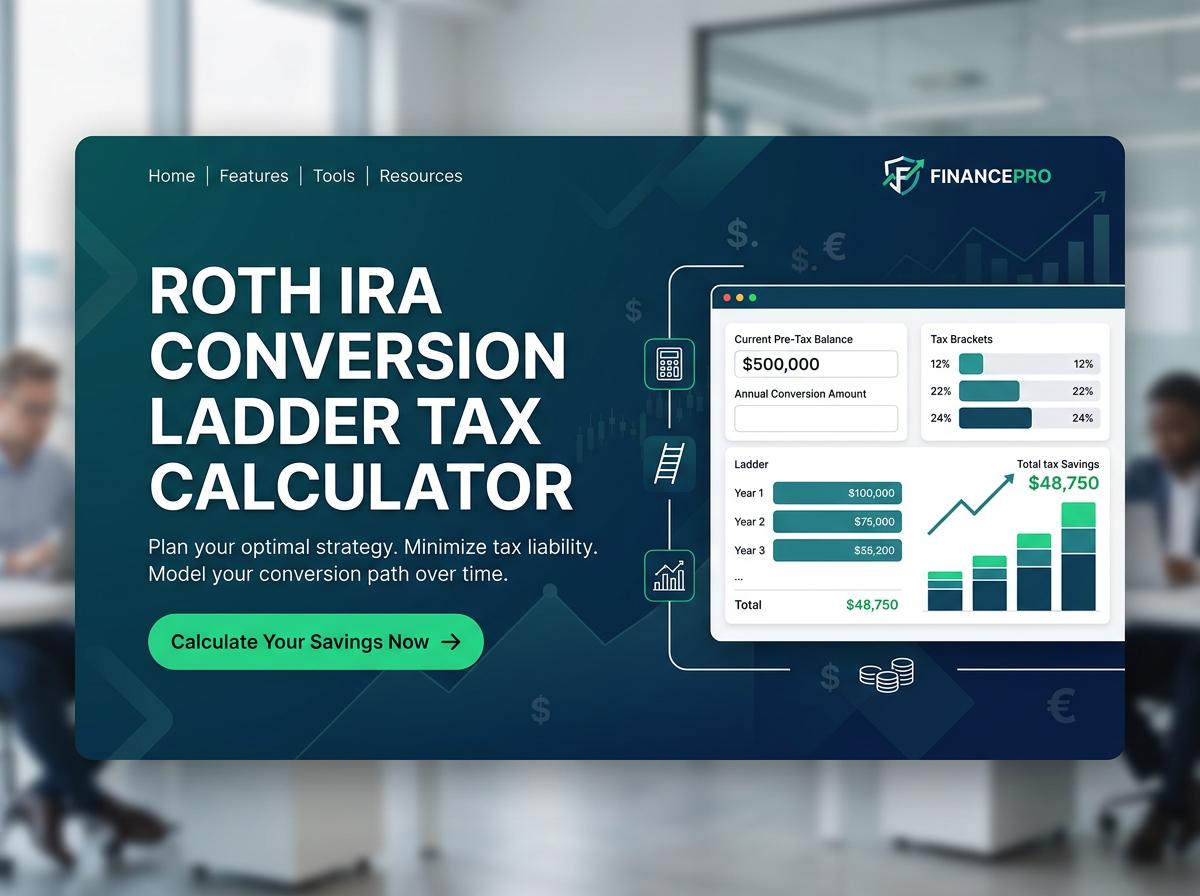

Optimize your early retirement with our Roth IRA Conversion Ladder Tax Calculator. Estimate annual taxes, minimize your tax liability, and effectively plan penalty-free withdrawals to optimize your FIRE strategy.
Roth IRA Conversion Ladder
How much ordinary income tax do you owe on a Roth conversion?
When you convert a traditional IRA to a Roth IRA, you owe ordinary income tax on the portion of the converted amount that was originally contributed pre-tax, plus any accumulated earnings.
For example, if you convert $50,000 of fully pre-tax funds and your marginal tax rate is 24%, you will owe $12,000 in federal income taxes. The exact amount depends on your total taxable income for the year, filing status, and whether you have a mix of pre-tax and after-tax funds. If you hold mixed funds, the tax owed will be calculated using the IRS pro-rata rule.
Will the converted amount push you into a higher marginal tax bracket?
Yes, it is entirely possible. A Roth conversion amount is added directly to your gross income for the tax year, which increases your overall Adjusted Gross Income (AGI).
Because the U.S. tax system is progressive, a large, single-year conversion might push a portion of your income into a higher marginal tax bracket. To minimize this impact, many taxpayers use a "bracket bumping" or partial conversion strategy:
- Calculate the remaining room in your current tax bracket.
- Convert only enough funds to reach the very top of that bracket.
- Repeat this process across multiple tax years to spread out the tax burden.
How does the five-year rule apply to avoiding early withdrawal penalties?
The five-year rule for Roth conversions dictates that you must wait five years before withdrawing the converted principal to avoid a 10% early withdrawal penalty, assuming you are under age 59½.
- Separate Clocks: Every individual Roth conversion has its own distinct five-year waiting period.
- Start Date: The clock retroactively starts on January 1 of the tax year you made the conversion.
- Age Exception: Once you reach age 59½, this 10% penalty on converted principal no longer applies, though earnings may still be subject to a separate five-year rule for tax-free withdrawal.
Should you pay the conversion taxes using outside non-retirement funds?
Yes, it is highly recommended to pay the conversion taxes using outside, non-retirement funds (like a checking or taxable brokerage account) rather than withholding taxes directly from the conversion itself.
If you withhold taxes directly from the IRA balance:
- Lost Growth: The withheld amount isn't deposited into the Roth IRA, meaning you permanently lose its potential for tax-free compounding.
- Tax Penalties: If you are under age 59½, the money withheld to pay taxes is treated as an early distribution, subjecting those withheld funds to an extra 10% early withdrawal penalty alongside ordinary income taxes.
How does the pro-rata rule tax mixed pre-tax and after-tax IRA balances?
The IRS pro-rata rule prevents you from cherry-picking only non-deductible (after-tax) funds to convert tax-free. If you have a mix of pre-tax and after-tax money across all your traditional, SEP, and SIMPLE IRAs, the IRS taxes the conversion proportionally.
Here is how it is calculated:
- Aggregate all non-Roth IRA balances into one total.
- Divide your total after-tax contributions by the total IRA balance to find your tax-free percentage.
- Multiply the planned conversion amount by this percentage to determine the tax-free portion.
The remaining percentage of the conversion is fully taxable at your ordinary income rate.
Are your Roth IRA conversions also subject to state income taxes?
Whether you owe state income taxes on a Roth conversion depends entirely on your state of residence.
| State Tax Policy | Impact on Roth Conversions |
|---|---|
| No State Income Tax | States like Florida, Texas, and Nevada levy zero state tax on conversions. |
| Retirement Exemptions | States like Pennsylvania and Illinois generally exempt retirement distributions, making conversions state-tax-free. |
| Standard Income Tax | States like California and New York treat the converted pre-tax amount as fully taxable state income. |
Always consult your state's specific tax code, as a high state tax burden can reduce the financial benefits of converting.
Will the added conversion income trigger higher Medicare premium surcharges?
Yes, a Roth conversion can trigger higher Medicare Part B and Part D premiums through the Income-Related Monthly Adjustment Amount (IRMAA) surcharge.
IRMAA surcharges are calculated based on your Modified Adjusted Gross Income (MAGI) from two years prior. Because a Roth conversion increases your MAGI in the year it is executed, a large conversion at age 63 or older could push you over the IRMAA thresholds. This would result in a sudden, temporary spike in your Medicare premiums two years later (e.g., a conversion executed at age 63 increases premiums at age 65).
When is the exact deadline to pay the taxes on a converted amount?
The formal deadline to pay taxes on a Roth conversion is Tax Day (typically April 15) of the year following the conversion. For example, taxes for a 2023 conversion are due by April 15, 2024.
However, because the U.S. tax system is "pay-as-you-go," waiting until April could trigger IRS underpayment penalties. If the conversion generates a significant tax liability, you may need to make estimated quarterly tax payments in the specific quarter the conversion occurred. Alternatively, you can increase the tax withholding on your workplace paycheck for the remainder of the year to cover the shortfall.
Can you still undo a conversion if the resulting tax bill is too high?
No, you can no longer undo a Roth conversion.
Prior to 2018, taxpayers could "recharacterize" (undo) a Roth conversion by the tax filing deadline if the market dropped or the resulting tax bill was unexpectedly high. However, the Tax Cuts and Jobs Act (TCJA) of 2017 permanently eliminated this option.
Today, once you convert funds from a traditional IRA to a Roth IRA, the transaction is strictly irreversible. Because of this rule, it is absolutely crucial to accurately estimate your tax liability and plan ahead before executing the conversion.
Which specific IRS forms do you need to report the conversion correctly?
To properly report a Roth conversion to the IRS, you will need to utilize the following tax forms:
- Form 1099-R: Your brokerage will issue this form early in the year following the conversion. It details the total gross amount distributed from your traditional IRA.
- Form 8606 (Nondeductible IRAs): You must file this form with your tax return. It calculates the taxable and non-taxable portions of your conversion, which is especially vital if the pro-rata rule applies.
- Form 1040: The final taxable amount calculated on Form 8606 is entered on your standard individual income tax return to determine your total tax liability.
Sources:
 Social Security Break-Even Age Calculator